Podmenti: read any podcast, and how the pricing actually works
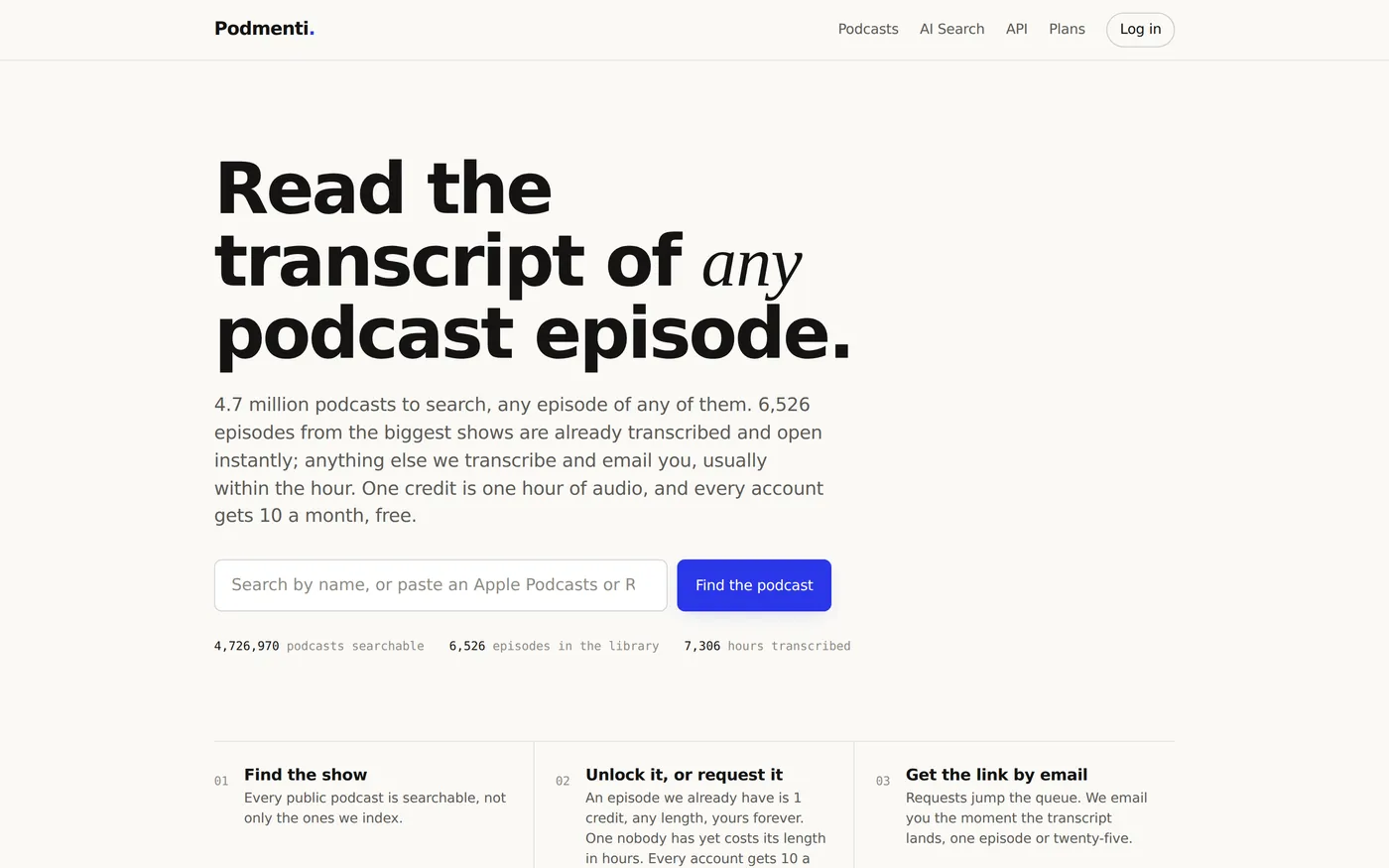
Podmenti went live on 31 August. It started as a side door to the Bookmenti transcripts and within a week it had turned into a real product with accounts, plans and an API. This post is about what it offers and how I decided to price it, because I went back and forth on that more than on anything else.
What it is
You search for a podcast - any public one, and the open Podcast Index has 4.7 million of them - open a show, and either read an episode that’s already in the library or tick the ones you want transcribed. The library right now is 6,526 episodes from the biggest shows, and those open instantly. Anything else goes to the front of the queue on our own machine, and you get a link by email the moment it’s done, usually within the hour.
Under the hood it’s the same transcriber that feeds Bookmenti: NVIDIA’s Parakeet model running on our own box at about 2.5 times realtime per worker, with word-level timestamps straight from the recogniser. One thing I’m proud of: podcast audio changes after publishing, because ads get swapped in and out, and every other transcript you find online quietly drifts out of sync. We detect the change and re-align every timestamp, on every plan.
The first pricing was wrong
The very first version had an email gate: give us your address, read the transcript. I rolled it back the same day. Collecting emails while promising I’d never send a newsletter is incoherent, and I didn’t want to be that site.
Then I priced unlocks at 10 credits. And when I actually sat down and asked what an unlock costs us, the honest answer was almost nothing - the episode has already been transcribed, serving it is a cache read. So that dropped to 3, and then I threw the whole ladder away and started from one question instead: do we already have it?
One credit is one hour of audio
That’s the whole price list now, and I’m going to give you all of it.
- An episode nobody has transcribed yet costs its length in hours, rounded to the nearest hour, never less than one. A 40-minute show is 1, a three-hour Rogan is 3.
- An episode already in the library is 1, whatever its length. Somebody already paid for the machine time, so you shouldn’t again.
- An AI Search query is 1.
- Finding shows and listing episodes is 0. Once an episode is yours it’s 0 forever - open it again, download it again in every format, never pay twice.
Why per hour? Because that’s what the work actually costs. A three-hour episode really does take three times the machine time of a one-hour one, and every real transcription provider prices per minute for the same reason. Flat per-episode pricing only works if you’re reselling transcripts that already exist.
The one other dial is speed. The fast lane runs the same episode on a rented GPU - our own container on an L40S at Replicate, the exact pipeline from the box with the segments batched - so a whole episode of any length is ready in a couple of minutes. GPU time costs us more, so it’s double: two credits per hour. It’s promised within five minutes, and if a job is late, or it fails and falls back to the standard lane, the premium comes back on its own.
The plans
Every plan, Free included, is a monthly allowance of credits that resets each cycle. No one-time top-ups, because I tried that first and it made the account page a mess.
- Free - 10 credits, no card. Ten hours of audio a month, or ten library episodes, or ten searches. It costs us at most about fifty cents a month even if someone spends all of it on brand-new transcription, so I’m fine with it.
- Plus - 120 credits for $9. A few episodes a week, some of them new.
- Pro - 500 credits for $29. A whole back catalogue a month.
- Business - 2,000 credits for $99, built for the API. Our cheapest hour.
Per hour of on-demand transcription those land between roughly four and eight cents, against fifteen at AssemblyAI and twenty-six at Deepgram, with the library and AI Search included. Each plan also carries a daily request allowance for the API, from 1,000 on Free to 50,000 on Business, because a script walking whole catalogues is real load on our copy of the index.
AI Search, and the API
AI Search is the paid-only thing. It’s the same kind of extraction that runs Bookmenti’s book pipeline, pointed at whatever you’re after: “brands recommended by name”, “every claim about sleep”, “people mentioned as guests”. You ask, it reads the transcript, you get quotes with timestamps. It’s gated behind a real purchase - free welcome credits can’t pay for it - because it’s the one thing here that costs us a model call per query.
And everything you can do on the site you can do over /api/v1 with the same key:
search, episodes, transcripts in plain text, timestamped text, .srt, .vtt and
word-level JSON, transcription jobs with an ETA you can poll or get a webhook for, and
AI Search. One episode is unlocked for everyone without an account, so you can open the
complete output in every format before you spend a credit.
Honest limit: it’s new. The library is big for the popular shows and thin everywhere else, and the fast lane’s five-minute promise is measured on typical jobs, not on someone dropping a hundred episodes at once (those get a longer promise, stated up front). But the shape feels right to me now - reading is free, the library is the product, and speed and bulk are what you pay for. What would you use it for? I read every message.